Showing posts with label Noam Chomsky. Show all posts

Monday, 7 April 2014

Review: The Basic Writings of Bertrand Russell

One more review.

Review: The Basic Writings of Bertrand Russell

Bertrand Russell, who by any standard is one of the leading intellectual figures of the twentieth century. He was one of the very few leading intellectuals who opposed World War I. He was vilified, and in fact ended up in jail, like his counterparts in Germany. From the 1950s, particularly in the United States, he was bitterly denounced and attacked as a crazy old man who was anti-American. Why? Because he was standing up for the principles that other intellectuals also accepted, but he was doing something about it.
                                                                             Noam Chomsky 

There can be few books that have been titled with such wilful understatement as The Basic Writings of Bertrand Russell. Any book which includes sections on philosophy, logic, mathematics, linguistics, relativity, education, ethics, psychology, history, politics, religion, metaphysics, epistemology, east/west relations and the future of the human race can hardly be described as basic.

Then again, by the standards of Bertrand Russell, perhaps this is basic. He was a prodigious writer on all of the above subjects and a great deal more and for years I have liberated copies of his many books with titles like Political Ideas, Sceptical Essays, In Praise of Idleness and The ABC of Relativity from second hand book shops.

I like Russell because he thought the things that may people think, but actually did something about them. He was born in 1874 to Lord and Lady Amberley, both of whom died when he was young, and he was raised by his grandmother, Lady Russell, in virtual isolation. It was expected by his elders that Russell would take up a career in politics, but his passion was for mathematics and philosophy. As a member of the ruling classes he could have taken the easy way out, acted as minister in a Liberal government, taken up his seat in the House of Lords, not been a bother to anyone. Instead, he went in the opposite direction, serving time in prison for his opposition to the First World War, being sacked from his professorship at City College in New York for his views on sexual liberation, vociferously supporting the campaign for nuclear disarmament. In 1957, Russell wrote an open letter to both Eisenhower and Khrushchev, calling for an end to the Cold War. Similarly, at the time of the Cuban Missile Crisis, he sent telegrams to both Khrushchev and John F Kennedy. Khrushchev assured him that Russia would not be reckless, whereas Kennedy returned his telegram unopened.

Most people would, I think, be glad to have lived half the life that Bertrand Russell lived, displayed half the bravery and understated intelligence that Russell displayed. What comes across from reading this collection of articles isn’t just the sheer depth and breadth of subjects of which Russell was informed enough to talk about, but also serves as reminder that simple ideas and statements sometime need to be reiterated. In my own writing, I often reject trains of thought as they seem so obvious that it would be patronising even to mention them.

Yet simple ideas aren’t always obvious to everyone and even when they are, they bare restatement as a kind of reset button when the world seems to have lost its mind. Russell’s thoughts on religion, politics and education are often simple but never simplistic. It’s worth being reminded that the purpose of education isn’t to teach but to indoctrinate, to question why agnosticism towards God or heaven is any less sensible that agnosticism toward Zeus or Thor, to remind politicians that global conflict is in no one’s best interest except the manufactures of the weapons. Russell never tired of stating and restating his thoughts on these subjects.

Russell’s principal academic pursuits though were in the regions of philosophy and mathematics and there is much in this volume regarding both subjects. Philosophy is often used as a dirty word in the scientific disciplines, yet I think many physicists would benefit from a working knowledge of philosophy, as would philosophers benefit from a little knowledge of basic physical principles. Sadly it is often a case of never, or rarely, the twain shall meet and before Russell, the last significant mathematician-philosopher was probably Rene Descartes in the 17th century. Russell wrote two major works on the history of philosophy, A History of Western Philosophy and Wisdom of the West, sections from both of which are included here. A History of Western Philosophy in particular has been used as a standard textbook in British institutions for many years and I can highly recommend it for anyone who wants a good overview of the subject, as well as a critical overview of some of the major triumphs and failures in thought of the philosophers in question,  through from Socrates to John Dewey.

For a general overview of the work and thoughts of Bertrand Russell himself however, you could do worse than start with The Basic Writings of… At 736 pages, you certainly get a lot for your money and while you will almost certainly find some of it going over your head (it has taken me three abortive attempts to get past the sections relating to Russell’s Magnus Opus, Principia Mathmatica), time spent with Bertrand Russell is never time wasted. He was a rare breed, of which maybe only the likes of Noam Chomsky or Tony Benn bear comparison. He was politically active right until the end of his life, spending seven days in prison in 1961 for his involvement in anti-nuclear demonstrations at the ripe old age of 89.

Russell died aged 97 on the 2 February 1970, exactly three years to the day before I was born. I would like to have known him, but he left such a plethora of publications that settling for the next best thing isn’t a million miles away from this desire. Our great and prolific writers get read less and less these days. It is our duty to reintroduce them to new generations. There is much that they can teach us.


Get it done.


Saturday, 25 January 2014

Functional Content

Today, language and education.  

Functional Content

Around ten years ago, I started to do an Open University degree in English and Philosophy. It seemed tailor made for me, modules on Shakespeare and Political Philosophy, all but one of the core texts of which I had already read at least once. To start though you had to do an Introduction to the Humanities course, which ran over three or four months, consisting of three short essays and one longer, final essay.

If I’m honest, my entire effort consisted of no more than about five or six evenings in total. It therefore might not surprise you to learn that I failed the course. However, I didn’t fail because of the standard of my final essay, which was marked as good and excellent. No, I failed because I hadn’t written up an essay plan. Or, rather, I had been too honest in stating that I didn’t find an essay plan to be beneficial or conducive to my way of working.

When I sit down to write, I usually have a rough idea of what I want to say. I might write down some notes, work out a few snags in a blank document, but the challenge always in writing is to translate the thing in my head as accurately as possible onto the page. If I thought about it too much, the quantum state might collapse. Essay plan be dammed.

For me this perfectly demonstrates the problems with the education system. Without wishing to turn into Johnny Rotten, education has little to do with learning, much more about learning to conform to fixed ideas. If one is going to be an engineer or a doctor, then obviously one has a lot to learn in order to qualify. These are useful professions. Yet law, history, the humanities and the like are much more about opinion and so opinions have to be reined in at an early age. Contrary to popular myth, not everyone can be a President or a Prime Minister, there are enough checks and balances in place at each and every level of the hierarchy to weed out anyone who is liable to upset the established order. As Noam Chomsky once remarked, no one tells the editor of the New York Times what to publish, if he had to be told he wouldn’t be editor.

As any smart child knows, you don’t go to school to learn, you go to school to learn how to pass exams. You learn to regurgitate the facts that the state wants you to accept as truth. That’s how you progress. Lately, this has been even more the case with our current Secretary of Education, Michael Gove. I am championing the cause to have Michael Gove be known as Mr Gradgrind by common consent, after the headmaster in Charles Dickens’s Hard Times:

"Now, what I want is, Facts. Teach these boys and girls nothing but Facts. Facts alone are wanted in life. Plant nothing else, and root out everything else. You can only form the minds of reasoning animals upon Facts: nothing else will ever be of any service to them.”

Which sums up the government’s education reforms quite nicely. Better to have children recite the names of Henry VIII’s wives than learn anything about the women themselves, or what their treatment teaches us about the history of misogyny and murder in the state. Why consider anything of the causes or consequences of the First World War, when we have a manmade myth to trot out for each new generation, one of assassinated Archdukes and Belgian neutrality?

History lessons already skip the bits of the First World War that have to do with empire building and the rush to acquire oil to fuel the recently converted British and German Navies. They also miss out the bit about Britain almost certainly being defeated without the late involvement of the Americans. My memory of school history lessons is the Germans of the First World War being portrayed as almost indistinguishable from the Nazis. Yet the Nazis wouldn’t have come to power at all without the humiliations that were visited upon the German people at the end of the war, leading to the Weimar Republic.

History is written by the winners. It also saves them the trouble of having to take responsibility for their own mistakes. And those who fail to learn mistakes of history are doomed forever to repeat them.

Michael Gove and the rest of the Tory party want to muddy the waters even further and portray the war as one big jape, all lads together, bashing the baby killing Boche. Most Tories probably yearn for the days of the First World War, because it was an era before the welfare state, where industrialists and the landed gentry could send millions of the lower classes to their deaths in sacrifice to their gods of profit motive. These days if they want to kill poor people, they have to send them to ATOS rather than the Somme.

American Physicist Richard Feynman describes how his father used to educate him as a boy. How he would point to a bird in a tree and tell his son that he could teach him the name of the bird in English, Chinese and Portuguese, on and on until, “you know in all the languages you want to know what the name of that bird is and when you’ve finished with all that, you’ll know absolutely nothing whatever about the bird.” Which is in stark contrast to our education system. At school we learn all the names for the various parts of speech, noun, verb, adjective and adverb; article, conjunction, preposition and ting (or a pronoun, as its also called). It’s this kind of learning that causes children to correctly exclaim, “When am I going to need to know that?” Probably never. Not unless you go on to do a language degree.

There is a more useful division to the parts of speech that is rarely taught at any level. One that can help people to listen and communicate more effectively and one which only requires the knowledge of two groups of words. I have already alluded to them in the previous paragraph. Nouns, verbs, adjectives and adverbs are collectively known as content words, whereas your articles, conjunctions, prepositions and pronouns are function words.

A content word is one which, well it provides content. A single word tends to contain a lot of information. For instance, consider the word, ‘man’. What can we say about it? At face value, very little, except that it’s a noun, it’s singular and it’s male. Closer examination however reveals much more information and allows us to make a whole range of assumptions.

Not only is ‘man’ a noun, but it is a concrete noun, describing a real world object, as opposed to an abstract noun like ‘fear’ or ‘opinion’. It also describes an animate object, unlike ‘stone’ or ‘toothbrush’ both of which are inanimate and unlikely to move of their own volition (excepting some kind of dream or fantasy sequence). And a ‘man’ is human, with self awareness, free will and the power of speech, unlike a cat or a dog. He is also likely to forget your birthday or to do the dishes or put the bins out (right ladies).

Now, consider the function word, ‘I’. What can we say here? Well, again we can see that it’s a pronoun, singular, unlike ‘we’, and takes the nominative form, as opposed to the accusative case, ‘me’. It’s likely to be the first word in a phrase that describes some action that the speaker is performing (‘I went to the shops’, ‘I feel sick’, ‘I noticed you looking at me’ etc.), but not much else. The speaker could be anyone, a man or women, an anthropomorphised cat, dog or toothbrush, even fear itself, depending on the context.

The job of function words is to flesh out sentences and give form to the content words. What’s interesting is that while in English function words account for no more than a few hundred words amongst the hundreds of thousands of content words, they can account for as much as much as half of everything we say. Amongst social groups, text messages or the language of teenagers, there can very little function without any loss of meaning. A text message which says, “Went shops today. Bought a coat.” makes perfect sense, even though it consists of two verbs, three nouns and only a single indefinite article, missing out four function words which would normally be required to make the message make sense (“I went to the shops. I bought a coat.”).

In academic writing, function can exceed fifty percent of the total word count. This is largely because many of those reading or writing such work will speak English as a second language and meaning, context and tone therefore have to be hammered out to a tedious degree. The same is true of legal documentation. It’s why academic papers and legal documents are usually so dry.

This can also be the reason why people can find themselves in trouble posting messages on Twitter. Being restricted to 140 characters, Twitter is essentially a text message that ends up being read by strangers who know nothing about you. Given Twitter’s restrictive nature, function is sacrificed for content, which in turn sacrifices tone and context. Whereas a friend may be able to interpret a sarcastic comment as sarcastic, because they know you and can hear your tone of voice, a stranger is more likely to misunderstand.

It’s The Inverse Law of Twitter Exchange, that the more complex the idea under discussion, the more likely it is to be misunderstood by one or more parties involved. Watch a Twitter Feed for any length of time and you will see at least one celebrity tweeting the words, “It was a joke. #ironyfail/#twitterfail” Twitter is good for promoting oneself, highlighting interesting articles or cat videos, it even allows comedians to hone the brevity of their stand up routines, but as a form of communication it’s slightly worse than saying nothing. These days I mainly use it as a kind of zip file, linking to articles like this, where the function words are allowed to roam free.

In the wider world of 141 characters or more, a greater awareness of function can help us to make sense of the world and weed out the ones who are trying to take advantage of us. Whereas function words tell us very little when taken in isolation, they are highly enlightening when considered in clusters. Take the last two sentences, for example. Notice how I’ve used the word ‘us’ three times. I, the writer, am trying to ingratiate myself to you, the reader, by describing ‘us’ using the same first person plural pronoun. It’s a common political trick. However (and I will leave to judge how much of the following you believe), ‘us’ is the accusative form of the nominative first person plural pronoun, ‘we’. This demonstrates at a stroke that I am using the passive voice, rather than the active voice. I could have said something like, We can make greater sense of the world if we pay closer attention to the use of function words.

My use of the passive voice is indicative of the level within society that I consider myself to be at, and, by extension, the level that I consider you, the reader, to be at. Moreover, ‘us’ is a more inclusive pronoun than ‘we’. Politicians say ‘we’. “We’re all in this together.” is a typical example, which is pretty meaningless when you think about it. It’s like a prison warder saying, “We’re all at the same prison.” Yes, but some of ‘us’ get to go home in the evening. There is also that most famous example from recent years, “Yes we can.” which again is pretty devoid of meaning and, given everything that’s happened since Barrack Obama’s election, is only half the real slogan, which is, “Yes we can; you won’t be allowed to.”

There are many other examples of what function words can tell us about a speaker. People who use too many personal pronouns, ‘my’, ‘mine’ etc are likely to be more selfish. People who speak about themselves in the second person are more likely to be withdrawn or lacking in empathy than others. Someone who says, “You go to the shops and you find it’s the same five companies every twenty yards.” is probably more narrow minded than someone who says, “Every time I go to the shops, it’s the same five companies every twenty yards.” because the latter speaker is recognising that this is only their opinion, while the former is more likely to believe that their opinion is the only valid one. It’s all in the function words.

People who talk about themselves in the third person should be given a wide berth. Robert Maher speaks this and IT IS LAW.

Paying attention to the function in speech is essential to assessing the sincerity of the speaker. Whether someone uses the referential determiner ‘this’ or ‘that’ can speak volumes about whether they feel close to an object or issue or are trying to distance themselves from it. 

If there was any political will to educate children or the public in general, the difference between content and function words would be the first thing about English grammar that we were taught. Yet in a system where subservience and conformity are all, anything of any practical use is kept sealed off in the upper echelons of English language degrees. I’m extremely well read yet I heard about content and function words not from a book on English, but in a New Scientist article. Luckily for the established order, the sciences and humanities have now been kept isolated from each other for a century or more.

That said, the difference between content and function words is something that I’ve always known, I just didn’t know that I knew it. When I speak about this to other people, they say the same. It’s probably something most people know about, they just haven’t been taught what it means.

I end today with Lewis Carroll’s classic nonsense poem, Jabberwocky. Notice however that only the contents words are nonsense, making the poem broadly readable. Without the regulating presence of it function words, the poem really would make no sense.

Education is like everything else. If you want it done properly, you have to do it yourself.

`Twas brillig, and the slithy toves
Did gyre and gimble in the wabe:
All mimsy were the borogoves,
And the mome raths outgrabe.

"Beware the Jabberwock, my son!
The jaws that bite, the claws that catch!
Beware the Jubjub bird, and shun
The frumious Bandersnatch!"

He took his vorpal sword in hand:
Long time the manxome foe he sought --
So rested he by the Tumtum tree,
And stood awhile in thought.

And, as in uffish thought he stood,
The Jabberwock, with eyes of flame,
Came whiffling through the tulgey wood,
And burbled as it came!

One, two! One, two! And through and through
The vorpal blade went snicker-snack!
He left it dead, and with its head
He went galumphing back.

"And, has thou slain the Jabberwock?
Come to my arms, my beamish boy!
O frabjous day! Callooh! Callay!'
He chortled in his joy.

`Twas brillig, and the slithy toves
Did gyre and gimble in the wabe;
All mimsy were the borogoves,
And the mome raths outgrabe.

Get it done.


Tuesday, 6 August 2013

A General, All Purpose, Omni-Directional, Jazz-Rant, Expressing My Dissatisfaction On a Number of Matters of Current Importance


Any idea, however brilliant, epoch making, or profound, has a half life, a period over which it becomes less relevant.

Any idea, however brilliant or epoch making, can become irrelevant over millennia or milliseconds, but so long as the arrow of time points forwards, the 2nd Law of Thermodynamics must be obeyed.

An idea may be brilliant, but ideas decay.

Or they evolve. Look at the Theory of Gravitation. Formulated by Sir Isaac Newton in 1687 in one equation and good for explaining 90% of the universe. It stood for 228 years, only to be superseded in 1915 by Albert Einstein's theory of gravitation, also summarised in a single equation, and good for explaining 99% of the known universe. One hopes that three centuries or so from now, we may have figured out 99.9% of the known universe. And quite a bit about the unknown as well.

Newer, more relevant information becomes available. What we take to be true today turns out to be nonsense tomorrow. Yet what remains entrenched in our psyche and our cultural identity can seem like a marvel. Some ideas are spellbinding. They seem to be doing most good, usually when doing most harm.

A couple of months ago I was watching something on television. I forget what it was, but the CEO of RBS was being interviewed. During the interview, he uttered the immortal line that I have heard repeated at regular intervals throughout my life:

Capitalism may not be perfect, but it's the best system we have.

I think Churchill made the phrase popular, but I've heard many politicians chant the mantra, especially Tony Blair.

It tells you a lot about capitalism, and about politics in general, because the phrase itself is a deceit on any number of levels. For a start, if something is imperfect, then by that very nature, it can be improved. The last two centuries of industrial and technological advance amply attest to that. It's kind of what capitalism is built upon. I have to upgrade my phone every two years, so why am I stuck with the same economic and political model that I was born with?

More than that though, it's a self-serving statement. I've seen a lot of TV reports from the slums of the world, but I don't remember a single one where a slum dweller sang the praises of capitalist ideology. Of course Blair, Churchill and the head of RBS think capitalism is great, all have done well from the system. It would be like being told a member of the Polit-Bureau thought Communism was the best system we have. I would be surprised if he didn't think that.

Beyond even that though, I just can't get my head around this notion that greed and the acquisition of wealth are what's best for society. Society is supposed to be an aggregation of people, an attempt to accommodate everyone's needs as best we can. How is that meant to be achieved when everyone is fighting everyone else for scraps? Competition tends to kill co-operation dead.

If I think back, these kinds of ideas have always been fermenting at the back of my mind. As kids, mum would take us to church, which wasn't especially puritanical, but they would say things that jarred in my head. I tend to obsess over things and the concept of hell blew my mind, not because of its horror, but because I couldn't see how such a place could exist and fulfil its primary purpose. Even then I understood the subjective nature of pain and I couldn't understand how it would be possible to keep someone in torment forever. Didn't all sensations become commonplace after a time, even pain?

It's what I would later come to realise was called a logical fallacy. By the time I'd turned teenager, I had ascribed heaven and hell to the same origin as Santa Claus. God and the rest of religion soon followed.

Yet imaginary or not, heaven and hell were intangible, invisible places. It was the tangible world that was more confusing to me. I heard about the EU wine lake and the butter mountain and then I saw the pictures from the famine in Ethiopia and couldn't understand why we didn't just give them the food they needed. Didn't we have enough to go around? Wasn't it just going off in a warehouse somewhere? Weren't we supposed to be the good guys?

If you grew up in the 80s, that was the line you were always being fed. We were the good guys; we who saw off Hitler single-handed, we who kept Europe from becoming rife with Communism. Communism, that was a terrorist octopus (no, they really called it that), spawned in Moscow, its tentacles everywhere.

Then I grew up and came to hear about Guatemala and Chile and Brazil and Argentina and El Salvador and East Timor and Vietnam and Cambodia and Laos and Iran and Iraq and the First World War and the Philippines and the Kurds and the Opium Wars and the Slave Trade and the eradication of the Native Americans and the Highland Clearances and the Harrying of the North and on and on, back beyond recorded time, and this was how good guys behaved.

I also heard about the twenty million dead Russians soldiers, how the Russians had lost more troops in the Battle of Stalingrad than the British and Americans lost during the entire war. How the Russians had defeated three quarters of the German Army singlehanded and might had marched on beyond Berlin if not for America's two shows of force at Hiroshima and Nagasaki.

Over time I stopped differentiating between this conflict or that, with their wide-ranging, but always dissembling reasons. Instead, I reduced them to a series of punishment beatings visited upon the poor, whether they be British Tommies or British Miners or Liverpool Dockers or Laotian Peasants. I was reminded the other day that the pre-industrial country of Laos had more tonnage of munitions dropped upon it by the USA between 1964 and 1973 than was dropped during the whole of World War Two. The cluster bomb was first tested on Laotian peasants (as napalm had been tested on French peasants at the end of World War Two). It remains littered with more unexploded munitions that any other country.

When asked why the north of Laos was being bombed, which had nothing to do with what was happening in Vietnam or Cambodia, one official let slip that there was a lessening of hostilities in North Vietnam, the air force had a load of B52s sitting around doing nothing, so why not give them something to do? Empty our silos of the old stock and send the bill for the next consignment to the folks back home. And the only people that get hurt are some peasants, who don't count for very much in a culture built around wealth and worthiness.

"Many men of course became extremely rich, but this was perfectly natural and nothing to be ashamed of because no one was really poor - at least no one worth speaking of." The Hitchhiker's Guide to the Galaxy

Of course, America's economy is practically built upon its arms industry. Selling weapons to the British during the Second World War was the main event that finally brought America out of the Great Depression that followed the 1929 Wall Street Crash. With the onset of the Cold War, most US research and development money went into applications of war, unlike, say, Japan, which was banned from having a military force, and so put all its R & D money into home applications. Japan ended up with Sony: America got Lockheed Martin.

Some ideas are spellbinding. I have friends who were barely alive when the Berlin Wall fell and yet the American military budget is now larger than ever. Shouldn't we have disarmed by now? Or at least re-aimed our missiles at the stars?

No. Instead we invent a new enemy that must be battled, so as to justify the ever expanding defence budget. The Evil Empire, as Chomsky so aptly named it, the Emmanuel Goldstein of Nineteen Eighty-Four, the scapegoat on to which we pour all of our hatred, to ensure that it is never focused on anyone or anything actually responsible for the current state of our society.

Islam it had to be. After the fall of the Soviet Union, Islam was the only game left in town big enough to scare the American public. The conceit, for the most part, has been about as accurate as it was during the Cold War. Most of Russia's alleged terrorist activities were black propaganda inventions of the C.I.A. Equally, the name Al Qaeda was largely an invention of the F.B.I. following the US embassy bombings in Nairobi and Dari Salaam in 1998. An attempt to create the image of a global Islamic terrorist network bent on destroying the west, despite the so-called Al Qaeda network at the time consisting of as little as twelve people. The name Al Qaeda was only used by Osama Bin Laden following the 9/11 attacks.

Yet as soon as the Soviet Union fell, the west's focus turned to the Middle East. From one Iraq War to another, through insinuations about the Oklahoma bomber, to the artificially inflated significance of the 1994 World Trade Centre bombing, to the threats and insinuations against Afghanistan, which might actually have led to the 9/11 attacks being launched as pre-emptive strike (a date for the US invasion of Afghanistan was announced and reported upon in May 2001). A self fulfilling prophecy, if ever there was one.

If you look at the west's involvement in wars throughout the 1990s, they can mostly be linked to attempts to prevent the curtailing of America's military budget. The first Gulf War, indeed Iraq's invasion of Kuwait irself, could have easily been prevented with a little diplomacy. Likewise, the bombing of Serbia had little to do with ending the ethnic cleansing in Kosovo. In fact, it triggered the vast majority of the violence against Muslims in retaliation for the aerial bombardment, exactly as the evidence indicated would happen at the time.  Every time the questions, Do we need so large a military?, Is N.A.T.O. really relevant in a post Cold War environment? were being asked, boom, another war breaks out.

With the 9/11 attacks, the US has been able to throw off its childish attempts to set itself up as a World Policeman, because now its military has carte blanche to spend however much of the gross national product on however many weapons it takes to destroy the people who want to destroy its 'way of life'.

Except, now that enemy is whoever we say it is. In Pakistan, in Afghanistan, the drones are taking down anyone of military age, ensuring the next generation of Jihadi fighters, ensuring the growth of western military and defence sectors for generations to come.

And so you get what we had in Woolwich. Which is the way they want it. Don't you think that if we were really serious about defeating fundamentalist Islamic terrorism, we'd have done all we could to play down the horrific events in Woolwich? Wouldn't we describe those two men as insane, like the media did when a British woman was beheaded in Tenerife earlier in the year? Or just not report it all, like weeks before, when a Muslim man was stabbed to death on the street by a racist gang in Birmingham? Wouldn't we do all we could to stress that those two man do not represent Islam, rather than focusing heavily on the fact of their religion, so as to avoid dealing with any political point they might have been making? Wouldn't we want to understand every facet of this barbaric act, to ensure that it never happens to anyone ever again?

Yet this doesn't fit our current narrative of scary Muslims, so we fall back on lazy stereotypes, which require no original thought. Clearly, hacking someone to death on the street in so causal a manner is the act of someone with mental health problems, whatever their stated cause. I mean, how many abortion doctors have been killed by fundamentalist Christians? These aren't labelled terrorist attacks. They're called what they are, extremist misunderstandings of vague and ancient texts. It doesn't mean Christians should be expected to apologise for the actions of a few random dickheads. Neither should Muslims.

Nor can we be entirely surprised that events like this happen. The national reaction actually said a lot about our collective sense of guilt. Scapegoats were called scapegoats, because they used to be exactly that: goats that people touched with their hands, in order to transfer the guilt of the person to the animal. A entire drove of goats would be used, sometimes slaughtered, sometimes released into the wild, depending on the local tradition. However, this idea of animals or individuals personifying the sins of society is as old as civilisation itself.

We blame Muslims and it absolves us of our guilt for twelve years of apathy towards the occupation of Afghanistan; our failure to bring anyone to account for the invasion of Iraq (the findings of the Iraq Inquiry will almost certainly not be published during the lifetime of this parliament); our grief at the number of our young men that have come home dead or disabled (and for what gain?); our shame at the thousands of lives that have been destroyed around the world; but most of all, it is our fear. Fear at the retaliation that awaits us. Fear that all of this death and destruction will have to be answered for someday. I may not believe in God, but I do believe in Karma. After all, Karma is nothing but a restating of the 2nd Law of Thermodynamics. Entropy increases, things even themselves out over the course of a season.

We evolve or we decay. Our economy is built upon industries that are toxic to modern society: oil, arms, banking and the like. Each has its tendrils deep in the minds of governments around the world and yet each is an anachronism, a throwback to a previous age, like the appendix or that ridge at the roof of your mouth that your reptilian ancestors used as a sensory pit. We have Google, Amazon and Starbucks to contend with now, so why are BAe, BP and Barclays still calling the shots?

To borrow from an astrophysics analogy, the only difference between the old Communist east and the Capitalist west is that the west is larger and so has other resources to draw upon, to stay-off its imminent collapse, but collapse it must. The east imploded, crushed by the differences in pressure between the image Russia portrayed of itself, and the reality of its situation. The west will go the same way, only with a bang, like another Rome falling. We seem to be ignoring this with the same casual regard that we ignore the evidence that global warming is occurring. I mean, we admit that it is probably happening, but no one seems to be doing very much about it. In both cases the signs are becoming less and less ignorable, yet day by day we do nothing. After 500 years of unfettered growth, the sun is finally beginning to set on the west. China, India and Brazil are where the future lie. These are the places where evolution is taking place. All thanks to the western expansion of globalisation. Thanks. And, you're fired.

Welcome to your capitalist utopia. Please brace for impact.

Even that they're calling it Capitalism again should be an indication of how bold they've become. There was a time, about twenty years ago, when the word capitalism was rarely heard. It was a dirty word. Then it got a rebrand: Consumerism. See, 'capitalism' suggests toffs in dinner jackets, top hats and bulging stomachs, lighting cigars off of £50 notes. Whereas, 'consumerism' focuses the mind back on sleepy shoppers shuffling around Tesco. Capitalists are heartless bastards, but consumers are lovely. What's more, the customer is always right. And if the customer is always right, then by extension, capitalism must always be right.

With political language, you should always be mindful of where your attention is being drawn and where it's being directed away from.

It's the same when we portray our soldiers as heroes. Now, I don't have anything against the military really. In an ideal world we wouldn't need an army, but we don't live in an ideal world, so an armed presence is sometimes required. I exist because my parents met on a naval base, so I've also seen how the country treats its heroes, once they've served their useful purpose. Bit of a pension and that's your lot. Don't even get special dispensation when you're long term unemployed. My mum was working, so he lost his benefit, died some months later. This is what you get for defending your country. Sorry, I may be a little bitter about the whole thing.

Wars are unpopular, especially the ones Britain has become embroiled in since the millennium, so we borrow from Capitalism's trick and shift focus. Rebrand. War is bad, but soldiers are heroes, fit young men in uniforms, defending our country from terror, even as they are invading someone else's country. A bit of sleight of hand and, Abracadabra, we pull attention away from the actual event, the invasion of a sovereign state (described in the Nuremburg Laws as the supreme international crime), and no one ever has to take responsibility for anything. At least, no one worth speaking of.

None of us like going to war, but you like soldiers don't you? You support our troops don't you? You are patriotic, aren't you?

I'm fairly indifferent to the country in which I live, as you'll know if you've read my essay on PJ Harvey. And while I'm not indifferent to the plight of British soldiers, the truth is that I don't see why they deserve my special attention over any other group that serves interests outside of mine. I don't want them being hacked down in the street, but neither do I want that for Muslims, doctors, or gay men either. Society is an aggregation of people, an aggregation of types, fitting within the agreed boundaries of society. Boundaries that change, as the evolution of our understanding leads us to expand the boundaries of what our society will allow. It fails when it blames one of us for the sins of us all, whether they be soldiers, Muslims, immigrants or the disabled. And if it fails one of us, it fails us all.

We should be very careful about the language that we use. I don't like the word hero, because it suggests a perfect state, which doesn't require any input from us. Heroes don't need help. I've met a few squaddies and some were sound and some were pricks, most were ok. I don't support the actions they are asked to carry out, but I don't blame them for them either. They're following orders and I just assume that the vast majority of serving personnel act, believing that their orders are given to them in good faith. So I prefer to think of them as victims of the same lies and distortions of which we are all victims. All to keep alive an economic model forged in the death throes of the Second World War.

'So our young men hit with guns in the dirt, and in the dark places'  (as PJ Harvey so hauntingly sings it), let us treat them better than heaping meaningless plaudits onto them, which make us feel better, but do nothing for them. If we instead thought of them as victims of the same global forces that swirl around us all, we might start to treat them a little better and, moreover, come to a better understanding about the people representing the Evil Empire of the moment. We might forge some kind of peace through negotiation and empathy and understanding for a change, instead of more boom, boom, boom. And in doing so, finally defeat our one true common enemy: the person pointing out all our enemies.

In the Victorian Age, the richest men built schools and hospitals and the country grew as a result. Today the same sections of the community are building PFI hospitals and prisons and pocketing the change. Instead of building people up, we've realised we've lifted them up far too far and are now trying to knock them back down again. In these days of Disaster Capitalism, making people miserable is the key, because profit can be made from human misery. Human misery is the great untapped well. Have you ever seen a list of the companies that Dick Cheney is involved with? It's a litany to human suffering, all monetised and extracted for most profit. America has the largest prison population in history, the bottom strata of American society having been criminalised and locked away, making cheap goods, in conditions fairly indistinguishable from slavery.

Shouldn't the best system that we know of be able to do a little better than this? Wouldn't our best system, having once abolished slavery, feel no need to reinvent it? Hasn't something gone terribly, terribly wrong?

Ultimately I hate the idea that capitalism is the best system we have because it's a statement of ownership. A message to ordinary people to say, we own you, and don't you ever do anything to try and change that, 'cause that shit's written in stone.

Mostly what it makes me want to do is try and change the system to a fairer and more equitable one: More like the one we were promised, once we got rid of the commies.

Isn't it time for some better ideas?

You may also like


"It's a round world, last time I checked." Bill Hicks

Saturday, 17 November 2012

The Sombrer Opacities of the Gloom: PJ Harvey & Let England Shake

I 

In  common with Nick Cave, I have little time for popularity contests. That said, the contest for Album of the Year 2011 was effectively over by mid-February with the release of PJ Harvey’s masterpiece, ‘Let England Shake’. Universally acknowledged as an instant classic the album’s almost spectral soundscape serves as perfect backdrop to Harvey’s evocative lyrics; lyrics that deal with the singer’s often tempestuous relationship with her country, especially at times of war.

While much attention was drawn to the aspects of ‘Let England Shake’ that deal with war, less was to be said about its lament to a nation’s decline. Perhaps the reviewers all felt too embarrassed, as the English generally are when it comes to discussing patriotism. Yet while PJ Harvey saves her most graphic images in capturing the consequences of conflict, the one word that reverberates throughout ‘Let England Shake’ sits at the core of its very title. England is the heart and soul here; the bringer of shame (you leave a taste, a bitter one) and yet even in its greyness and its grime it is the daydream of soldiers sat stagnating in battles past and present.

Oh America. Oh England.

'Let England Shake' is not a jingoistic album. A difficult balance is maintained between passionate cry and dispassionate appraisal; between the love of the land, the acceptance of its shortcomings and the disapproval at its darker episodes. England, that name resounds through the three opening tracks. Songs that are sung in eulogy of better days, that conjure Blakean visions of the Thames ‘glistening like gold’ in the memories of battle scarred minds, that chide the US and UK in disappointing tones for the orphans that their wars have left untendered (What is the glorious fruit of our land? Its fruit is deformed children. What is the glorious fruit of our land? Its fruit is orphaned children). 


Personally, I have a troubled relationship with the country of my birth. Technically I am Scottish, my submariner father having been stationed at Faslane when I arrived, mewling, into this world. For years after coming south, I clung to a pseudo-Scots identity, especially after moving to East Lancashire, where anyone born further away than Rishton was treated with idle suspicion (see Modern Epilogue). With my professed Celtic origins and my accent cobbled together from half a dozen places we had lived in over the years, I felt a perverse pleasure at being so alien in a place already so suspicious of outsiders. There I heard casually spoken the kind of racist vitriol that should have filled any rational being with revulsion, aimed against people one barely saw really. That crystallised in me a certain hatred for the English, with their petty mindedness and their hypocrisy and their cries for fair play, unless it involved diddling some third world country out of its natural resources. And I knew that it wasn’t so much that I wanted to be Scottish as that I didn’t want to be English.


And here’s the nub of the matter. Generally people aren’t looking for somewhere merely to belong, they’re looking for something to rally against: To be in dynamic opposition against. That’s really why people go to the football or form breakaway religious sects, so they can condemn and abuse those who hold marginally different views to them. I was no different. I had no Scottish friends, I was a member of no societies, I observed no traditions or holidays, yet the fact that I was born in Scotland meant I wasn’t English and I could wind up my English mates every time they got unceremoniously dumped out of the latest footballing tournament. I felt an affinity with the Asians in the town, paying special attention to be polite, courteous and grateful in shops, in a futile attempt to show that not everyone around here was gormless and ignorant. As usual I sided with what I perceived as the underdog, a curiously British, if not English, trait.

I should’ve figured it out much sooner than I did, but eventually I came to a solution. The people that I was angry with weren’t English. They were working class men from a depressed, post-industrial northern town that had had a new ethnic group introduced into its population right as the town’s fortunes took a nose dive. Many mistakenly saw in that cause and effect rather than symptoms of the same malaise. Ironically, it was the increase in living standards that the mills brought to the towns of the north west that ultimately led to mass immigration. Better schools meant better education, which meant better prospects for the general population and the mills were suddenly deprived of the factory fodder on which they had always relied, leading their owners to import cheap labour from the hot house of the sub-continent, already acclimatised for the hot house of the mills. So when I look back on those countless idiots spouting off about the trouble with the Asians, I can take a perverse pleasure in knowing that the Asians probably wouldn’t be there at all if these bozos’ parents hadn’t had the nerve to want their children to be able to read.

The person who did more than anyone to force me to confront and rethink my own prejudices was John. John was born and bred in this part of the world and yet unlike most everyone else I knew he didn’t just look out of his window, identify the first person that looked different to him and heap all of his misfortunes on their shoulders. John wanted to be different. So did I and that made us fast friends. That and a weird sense of humour.

Often we would sit up ‘til the early hours, amusing ourselves writing spoof newspaper articles or offering continuous commentary on the shit on late night TV or just talking into the early hours on matters weighty and irrelevant. Time and again in these debates the same two topics reared their confrontational heads: pride and nation. Their appearance was always guaranteed to raise the stakes. John delighted in challenging my notions of pride, which I saw as an entirely negative emotion. I kidded myself that I preferred to be humble in my achievements, but really it was that I preferred simple understatement for greatest effect.

Discussions of nation were always subdivided into two sub-categories; a) John’s pride in his nation and b) Rob’s sniffy attitude towards John’s pride in his nation:

J: I’m proud to be British.

R: Why?

J: Why? Because of warm beer and red post boxes and cricket on the green, that’s why.

R is confused by this. Post boxes are yellow in France, blue in the United States. So what? And as he was to discover years later, post boxes in Britain were originally painted green, but people kept walking into them.

I argued that if he took pride in anything as random as the colour of a post box, he should also feel shame for slavery and assorted other colonial crimes. John declined this invitation, stating that slavery had nowt to do with him. I countered that the Royal Mail’s colour scheme had little to do with him either, but he still seemed to want partial credit. He’d put up a spirited defence and we’d argue over the main points again, like running a biro over a well-worn shape on a pad.

Still, there was little that was said there that failed to make its mark, no matter how stubbornly it was rejected at the time, and over the years those same arguments sat fermenting at the back of my brain. I expanded my scope beyond mere borders. It was useless to talk of England and Scotland in this context. What were England and Scotland anyway? Northumbria used to be part of Scotland and most of the north west was at one time part of Wales. In order to be scientific, I had to consider a geographical region, not an arbitrary, amorphous tax zone. That could only mean Great Britain at large.
While I could wriggle out of being English, I couldn’t escape being British. It’s amazing how one’s attitude changes when one is forced to integrate with that group (humour). Actually, I have to admit that I am typically British in many ways. There’s the love of the plucky underdog, the obsession with the weather, the twenty a day tea habit. People here are also very tolerant, chiming well with my chosen philosophy, which states that what people do behind closed doors is their own concern (excluding the abuse of others). When comedian Richard Herring grew a toothbrush mustache in order to gauge modern day public reaction to something synonymous with Hitler, he was left pretty much unaccosted throughout the country. During the Second World War that same toleration and love of the underdog led English publicans to refuse US Army requests to segregate their premises. Segregation didn’t square with British notions of fair play.

Which isn’t to say Britain always plays fair. The concentration camp was a British idea; the first ever aerial bombardment of a civilian target was committed when Britain bombed Iraq. And of course Britain was heavily involved in the slave trade: the fortunes of its North American colonies were predicated on slavery, as were those in the Caribbean.

However, it’s all too easy to get caught up in post-colonial guilt and start to believe legends based on half-truth. While it is true that British troops gave small pox blankets to Native American tribes people, this was done as a gesture of good faith rather than genocide. The small pox hospital in question was empty at the time and the British had no need of the blankets. Meanwhile, it turns out a virus like small pox spreads by person to person contact not through soiled linen. The Native Americans got sick because they were exposed to diseases carried by Europeans from the Old World, which is why in the end they tried to keep themselves to themselves (until we went looking for them).

No matter how you divide or sub-divide a community, you will always find good and bad at the margins, with the rest regressing to a societal norm. Those wishing to lionise or demonise that community look only to its margins, and to only one side at that, forming a brand new nation in their minds as they do so (it’s the very confirmation of the theory of confirmation bias). Yet before you can know where you're going, or what you should be doing, you have to know where you are and how you got there. More importantly, you have to accept where you are: be grounded in the reality of where you are. And this brings me back to PJ Harvey.


While the disembodied voices of long dead soldiers echo through its halls, ‘Let England Shake’ is an album for the here and now. Harvey knows where England is and how it has arrived at this point. And she knows its future looks bleak. I fear our blood won’t rise again. Is it her fear or folksy acceptance of the inevitable? It’s a damp, grey place, full of fog and graveyards and dead sea captains and fetid alleys that host acts of drunken violence. And yet this is home.

What's striking about ‘Let England Shake’ is how brutally honest it is in its patriotism. It shows England at its most depressed and holds it up as a thing of beauty. It’s a tough love to be sure, the way only a parent can love a child, but it's the kind of national attitude I can tip my hat to, in my tolerant British way. I don’t have to agree with the sentiment to admire its honesty.


As with Polly Jean, so with John. John doesn’t wear his national pride on his sleeve, he keeps it locked in his chest. You won’t see him hanging a flag of St George on his car or out his window, but he’s still proud of where he comes from. And how far he’s come. And despite my still tricky relationship with pride, I’m proud of him too.

Isn’t it great that we’re all better people?

As for me, I no longer suffer the same violent reactions towards expressions of national pride. I still feel a little uncomfortable when the bunting is hung out for international tournaments, but I’ve long since come to realise that it has nowt to do with patriotism. The individual, that’s who I always most wanted to be, the kid doing his own thing.  Of course large groups of people united through a common focus make me uncomfortable, it goes against everything in which I idiotically believe. Still, it’s a small price to pay, because while it may be a way short of the best, Britain is a better place to live than most. It is still one of the very few places in the world where one can be an individual without harassment from religious or political authority. And in that respect at least, I attribute my British passport to good fortune.

Ultimately it comes down to familiarity. It’s familiar here. It would be the same wherever I was born. Yet before you can know where you are going, you have to know where you are; be grounded in the reality of where you are. Yes, I was born in Britain. I attach no pride or shame to that event. It was a long time ago and I don't really remember that much about it. It's fine. Moving on...


II

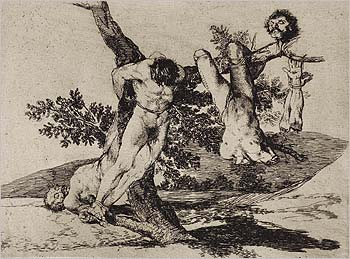
Even seen from the distance of two centuries, Goya series of prints 'The Disasters of War' still have the capacity to shock. They depict the numerous atrocities that both sides committed during Napoleon's invasion of Spain. It's hard to know how much of what Goya drew he actually witnessed, but he reproduces each scene with visceral immediacy. Executed men tied to posts, pathways littered with corpses, body parts hanging from trees; it makes one thankful we live in such a sedate corner of the world these days. 
Europe was entrenched in yet another war at the beginning of the nineteenth century. It was a time when politics fired artistic passions. French artist David had helped unleash the guillotine upon the aristocracy during the 'Terror' and now fawned over Napoleon. Beethoven had idolised Napoleon, but turned against him upon hearing he'd declared himself Emperor. Tchaikovsky celebrated the beginning of his downfall with the appropriately triumphant '1812 Overture' and Tolstoy wrote at length about the affair long after it was all over.

Although not displayed until long after Goya's death, 'The Disasters of War' were one of the first attempts at a kind of documentary photography. Long before the invention of the camera, Goya was sketching in sharp focus. There is much of 'The Disasters of War' in the photography of Robert Capa and Don McCullin. The images were also influential in the mind of one  PJ Harvey.

'arms and legs were in the trees'
Goya's greatest composition came out of that same outrage at Napoleon's incursions into his homeland. 'The Third of May, 1808' is perhaps the most powerful comment on war ever committed to canvas. Everything that war is about is encapsulated in that one image. The bloodied pile of corpses, the anonymity of the executioners, the fear in the faces of the onlookers, the sacrificial, Christ-like, pose of the condemned man. It is an image that truly speaks a thousand words.

 
For as long as men have gone to war, they have sought to recreate the experience through a variety of artistic forms. Writing, painting, music, photography and film have all been employed to varying effects to capture something of the sights, sounds and smells, the sensory overload and outright dislocation of battle, rendered knowable for the benefit of those thankful to be spared its horror. The twentieth century saw slaughter conducted on an industrial scale from its beginning to its end. Wilfred Owen equated the men conducting the First World War with Abraham going against God's commandment and slaughtering his son, 'and half the seed of Europe, one by one', in a return to the practice of human sacrifice. He died a week before the Armistice was signed.

What passing-bells for those who die like cattle?

Only the monstrous anger of the guns.
Only the stuttering rifles' rapid rattle
Can patter out their hasty orisons.

Poetry was still in vogue back then, as it had been since the rise of Napoleon, and for many in Britain what was happening over the channel was first communicated to them through the poetry of Owen, as well as Siegfried Sassoon, Robert Graves and Rupert Broke. Today they are as part of the national conscious as Shakespeare or Blake. Poetry's influence would decline over the years as new forms of entertainment were invented, but the war poets impact is so great that they are almost mandatory on any English Literature course in Britain. Tune in to any radio or TV station around 11th November to hear them recited as part of Remembrance Sunday commemorations. Like Homer's Iliad, they capture the boredom and the inertia that sets in between the violence.

If I should die, think only this of me:

That there's some corner of a foreign field
That is forever England.

While the English related their experiences through verse, other nations turned to prose. American Ernest Hemingway used his time as an ambulance driver on the Italian Front as the basis for his 1929 novel, 'A Farewell to Arms'. Hemingway was badly injured by a mortar shell and the book focuses on his alter ego, Henry, and his relationship with the nurse who tends him back to health. It's a romantic novel, told in that tough, plain way that Hemingway is famous for, but he doesn't shy away from the grim realities of war.

German, Erich Maria Remarque gives us a perspective from the other side of the trenches. 'All Quiet on the Western Front' humanises the 'enemy', shows him as being subject to same propaganda, witness to the same horrors, paralysed by the same terrors. The Nazis burned it on their pyres of banned books.


For most horrific war novel however there is only one contender and that is the panic inducing, 'Johnny Got His Gun' by Dalton Trumbo. 'Johnny Got His Gun' relays the inner monologue of an injured American G.I. as he slowly comes to realise the full extent of his injuries. Both his arms have been blown off by an explosion, as have his legs, all his senses likewise destroyed, only one small patch of skin on his forehead has any sensation remaining. He is in solitary confinement in his own body. We hear his claustrophobia, his panic, his desperate wish to die. The technique is simple and yet the effect is devastating.


'Johnny Got His Gun' may be the greatest anti-war novel ever written. Indeed it is so powerful that it was banned during World War Two. A film version was made in 1971 and in 1987, fifty years after it was written, heavy metallers Metallica recorded, 'One', based on the novel. But then when it comes to approximating war, there really is only heavy metal can do it justice (see Slayer's 'War Ensemble', habitually used by US troops in pumping themselves up for battle).


With 'Let England Shake' there is no attempt at approximating the feel of war, merely an attempt to present a soundtrack against which to project its voices. PJ Harvey's lyrics call to mind many conflicts, but time and again they return to World War One. She knows the old adage that those who refuse to learn the mistakes of the past are doomed forever to repeat them and deliberately comes back to a conflict that is now a century in the nation's past. History repeats itself. There was death then, there is death now. A hundred years ago young men were massacred by their millions on the fields of Belgium and France. Today those figures are dramatically reduced. Yet whereas the vast majority of war casualties used to be soldiers, today they are mostly civilians. Not that we even call them wars anymore. Wars have battlefields.

Often neglected in history lessons is the Spanish Civil War that broke out in 1936. And yet as in Napoleonic Europe and the trenches of the First World War, it set artistic passions ablaze. It was a place to which to rush and defend from the fascist forces of the Nationalists. George Orwell joined the POUM Militia, a leftist Spanish political party. He wrote 'Homage to Catalonia' about his experiences, including being shot in throat and witnessing the street fighting that broke out in Barcelona and pitted factions in the left against one another.
 
Orwell in Barcelona, 1936, near the back, a clear head taller than anyone else
 
Hemingway made propaganda films for the Republicans and in 1940 published the novel, 'For Whom the Bell Tolls', the tale of an American soldier who joins a group of Spanish guerillas to dynamite a bridge used by Franco's fascists. It's another tough tale from our Ernest and his most accomplished. The English poet Laurie Lee meanwhile had been tramping around the Spanish countryside at the outbreak of war and at the end of 'As I Walked Out One Midsummer's Evening' his hosts are endeavoring to find him passage out of the war zone. In 'A Moment of War', Lee depicts his journey back into Spain to try and join the fight. He is imprisoned as a Nationalist spy, then released to join the International Brigade. After anticipating battle for so long, he finally kills an enemy soldier in a skirmish and decides war is not for him.

The Spanish Civil War is a fascinating moment in history because it was the first concerted effort against the rising menace of fascism upon the continent. Hitler was an opportunist, he gained territory by chancing his arm and getting away with it. The elites of Europe were still trying appease him and hoped he'd go away. Read the literature of the day and it seems it was already to clear to many by 1936 that war between Germany and Great Britain was inevitable. Spain was a first chance to take the fight to the fascists.

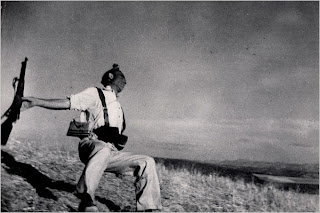
The Falling Soldier - Robert Capa
And in the spirit of Goya, the defining image of the Spanish Civil War, one of the defining images of art in the twentieth century, is Picasso's 'Guernica'. Picasso painted 'Guernica' in response to the bombing of the Basque village of the same name by German and Italian planes. You don't really appreciate the impact of' Guernica' until you have seen it up close and personal. The canvas is enormous, the twisted, tortured faces filling the vision. It's no wonder the copy in the UN was covered up when Colin Powell came to plead his case for war with Iraq.

Guernica
Yet the warnings were not heeded and we all know the result. The slaughter of the Second World War was once again on an industrial scale. The consequences and the aftereffects reverberated through the Suez Crisis and Korea, into the Vietnam War. More tons of TNT was dropped upon the counties of Vietnam, Cambodia and Laos than were dropped by all sides during World War Two, including both atomic bombs. The century ended as it began, with slaughter, and all that appeared to have changed was that we had outsourced the casualty figures to the 'enemy' of the day.

The twenty first century began with a bang, quite literally, and the shock wave from the attacks on 11th September 2001 have been circling the globe ever since. They should have caused us to pause and take a good long look at ourselves. Instead the same rhetoric was trotted out to push the same imperialistic ambitions that would have existed whether there was Osama Bin Laden and the Taliban or not. The war in Afghanistan has now gone on nearly twice as long as the Second World War, three times as long as the First World War, and few people understand what it's all about. Even if the reasons given for the invasion were accurate, they surely ceased to be relevant long ago.

PJ Harvey asks these questions. Her lyrics serve to show how no one involved in war benefits from its destruction. Family life is decimated, the fertile ground is ripped open, soldiers are haunted by the things they are ordered to do. Harvey uses the past to examine the future and ask why things seem to have changed so little in a hundred years.

Walker's in the wire, limbs point upwards, there are no birds singing 'The White Cliffs of Dover'.

Yet there is a glimmer of hope here. Noam Chomsky reminds us that things do tend to get better, despite concerted efforts to slow the pace of progress by those in power. We can, he notes, talk about differences of opinion within today's equal rights movement, yet try even talking about equal rights a century ago. The concept would have been baffling.  Civilisation slowly evolves.


The two most thoughtfully polemic works written in response to the 9/11 attacks were both written by women: Suheir Hammad's 'First Writing Since' and Ani DiFranco's 'Self Evident'. Both were composed by Americans directing their anger back at their own nation and calling it to account. They actually asked how this could have happened and offered suggestions that didn't resort to simplistic accusations of jealously. They express the anger left by the attacks, but they ask for solutions that don't revolve around the same old cycles of death and retribution.


With PJ Harvey's 'Let England Shake' we have perhaps the most effective and succinct commentary on the wars of recent years. Until even recently women's only role in war was as grieving mothers or victims of invading armies. Finally they have achieved a voice. And there really is no way to say that without sounding patronising, because it should have of course been that way a long time ago. Yet this where we find ourselves.


The global arms industry is worth tens of trillions dollars each year and the international community at best ignore and at worst ferment local conflicts and fuel the trade in weapons (Chomsky and others argue that it was the outbreak of the Second World War that ended the Great Depression in America and the US economy has been reliant on its arms industry ever since). Austerity is everywhere and people still die like cattle and it can seem like we're sliding back to the days of the workhouse and trench warfare. Yet things still improve. Ultimately the will of the majority wins through, even if it does take a century of trying. History does not repeat itself, but moves in waves. It goes up and down, with some repetition, but is always moving forward, playing variations around the melody as it goes. History is the world's longest standing jazz solo.

It's refreshing to see an album written about such a controversial subject was lauded by the press upon release and found instant success. Only the Daily Mail seemed to misunderstand, saying 'Let England Shake' drew no conclusions about the Iraq War. That's the Mail for you. For the rest of us, it's good to be reminded how things still tend towards the better. And at the risk of repeating myself, before you can know where you're going, it's good to remind yourself of where you are. If you believe you're trapped in a vicious cycle, you will repeat the same mistakes forever. To know history is moving forward is begin to put the mistakes of the past behind you.

'Let England Shake' takes its place in the pantheon of crucial commentaries upon war. From Thucydides to Julius Caesar, Delacroix to Dali, The Clash singing of 'Spanish bombs in Andalucía' and Lemmy's uncharacteristically tender vocals on Motorhead's '1916', right up to PJ Harvey, each new addition to the genre freezes war as a moment in time for our appraisal and careful consideration. In these days of virtual online battlefields and drone bombers operated from halfway around the world, the western mind has become almost entirely removed from the consequences of war. Many are still affected by them, soldiers and civilians alike. The conflict in Afghanistan rumbles on into its thirteenth years with no end in sight. It may be the war-without-end predicted by George Orwell in Nineteen-Eighty Four. PJ Harvey is an antidote to the apathy felt towards wars being waged that barely affect European life. She reminds us of why we should feel aggrieved. Perhaps if we paid greater heed to our great war chroniclers, they might instruct us to a clearer path towards peace.


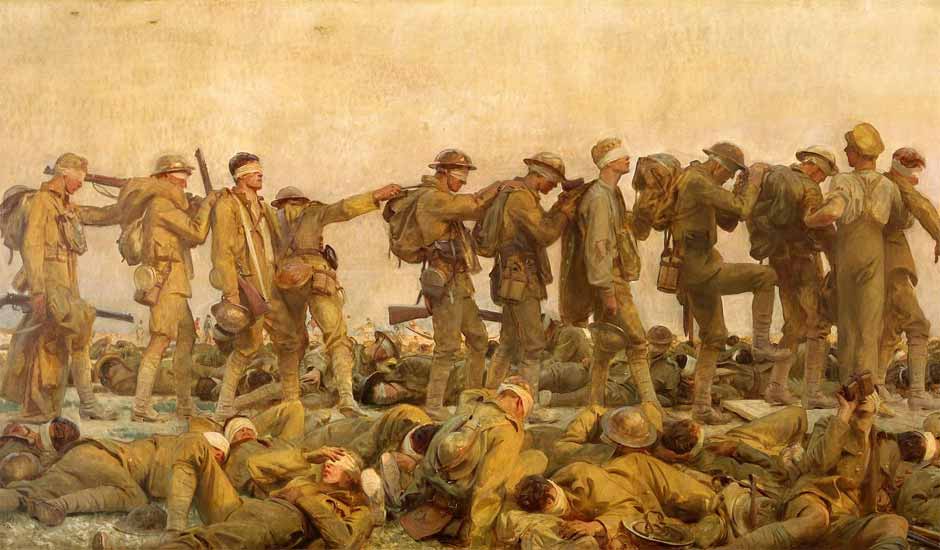
Gassed - John Singer Sareant


III

In common with with Nick Cave, I have little time for popularity contests. That said, it was good to see 'Let England Shake' win the Mercury Music Prize. It was the most predicable, least contested outcome in the brief history of the contest. PJ Harvey became the first artist to win the award for a second time. She got to enjoy this one. 'Stories from the City, Stories from the Sea' was announced winner in somber tone on 11th September 2001. Harvey was in Washington DC on the morning of the attacks. That experience began a decade long quest to understand the consequences of the event and to make a definitive statement about it. That the Mercury result never seemed in doubt is a testament to how well she succeeded in her efforts.

  
I remember seeing PJ Harvey at Manchester's Bridgewater Hall around the time her previous album, 'White Chalk', came out. Standing alone on a stage usually occupied by the Halle Philharmonic Orchestra, she filled the hall with sound with nothing more than electric guitar and vocals. It was a little disconcerting at first to realise she was going to be performing alone, but spellbinding to hear songs like 'Rid of Me' and 'Big Exit' stripped of any backing, making Harvey work all the harder to match their intensity.

She was chatty, nervous, confessing it terrified her playing solo. Switching to piano, she kept time with a metronome, apologising that she was still learning. It only added to the evening's charm. The new album was more melodic, more melancholic than the driving guitar riffs of her previous two offerings. Regret had replaced attitude. It was as she has always done, switching styles, trying something new. Yet the elements that would characterise the sound and the style of 'Let England Shake' were coming together that evening: the prepared piano, the autoharp, the long flowing dress of an Edwardian steam punk. The feather headdress was all she lacked at that point.


The concert ended with a standing ovation and we went away feeling that Polly Jean was well on her way to becoming a national treasure. Her idiosyncrasies developed over the years. Like wearing feather headdresses. Well if you going to be regarded a national treasure here, you have to develop a few eccentricities first. Ordinariness in our cultural icons just won't do. 

Following years of intensive research into the history of British conflict, Harvey emerged in her mercurial new guise as messenger and medium to the ghosts of war. Despite their shifting styles, her previous albums had been strictly personal affairs, raw and introspective. With 'Let England Shake', she almost removes her voice from the action altogether, serving only as a conduit to the lyrics. With that comes a greater aloofness, you can see it in her live performances, standing separate from the band, remote and distant. It's all part of the drama. 'Let England Shake' is as much a piece of theatre as it is a piece of music. All so different from that nervous, carefree night in Manchester not so many years ago.


My favourite fact about PJ Harvey is that she used to send advance copies of her albums to Captain Beefheart. My least favourite fact is that Captain Beefheart didn't like 'Stories From the City, Stories From the Sea'. Which is a pity, 'cause I have a fondness for that one. It reconnected me with PJ Harvey. The album almost entirely passed me by for a couple of years. Indeed, Harvey was owed the award for Least Contested Mercury Music Award having previously received the award for Least Noticed Mercury Music Award. Even Harvey seems to have virtually disowned the album these days. It's easily the most commercial thing she's released, but a solid rock album with some great tunes. And even some of Beefheart's best albums were commercial. Commercial for Beefheart that is (see 'Clear Spot'). I wonder what he would have made of 'Let England Shake'.

The sides of 'Let England Shake' that are shaded by war are perhaps universal to all, but there are other sides that can only really be appreciated when you've lived here awhile. Like reading Orwell's 'The Road to Wigan Pier', it doesn't leave you feeling patriotic or ashamed, just presents you with a picture of Britain that you can recognise and understand.

Like 'Johnny Got His Gun' or 'The Third of May 1808', 'Let England Shake' will remain timeless in its relevance and appeal. It's an album that speaks of the times it was written in, but has a atmosphere that is itself timeless. There isn't another album that sounds anything like it. I can't wait to see what Harvey tries her hand at next. With Beefheart for a mentor, anything is possible. An opera on the life of Emma Goldman perhaps? Whatever it is, I only hope she doesn't need to spend four years researching the next one.